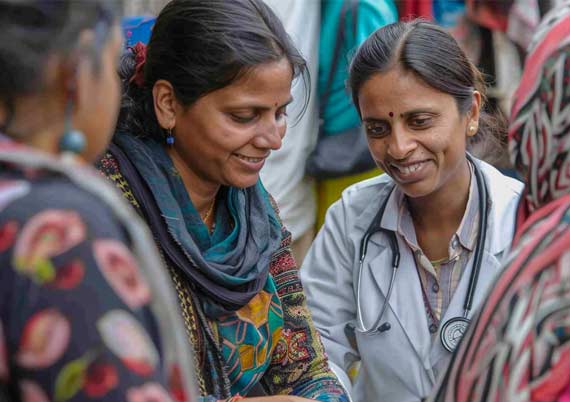
Rural Health care is one of biggest challenges facing the Health Ministry of India. With more than 70 percent population living in rural areas and low level of health facilities, mortality rates due to diseases are on a high.
DHO (DISTINCTIVE HEALTH ORGANIZATION) provides door to door reach out (villages in extreme remote areas) and applies best practices in the field. Our services cater to health care sector, social sector, and corporate organizations for connecting with the difficult to reach markets at bottom of the pyramid.
Healthcare is the right of every individual but lack of quality infrastructure, dearth of qualified medical functionaries, and non- access to basic medicines and medical facilities thwarts its reach to 60% of population in India. A majority of 700 million people lives in rural areas where the condition of medical facilities is deplorable. Considering the picture of grim facts there is a dire need of new practices and procedures to ensure that quality and timely healthcare reaches the deprived corners of the Indian villages. Though a lot of policies and programs are being run by the Government but the success and effectiveness of these programs is questionable due to gaps in the implementation. In rural India, where the number of Primary health care centers (PHCs) is limited, 8% of the centers do not have doctors or medical staff, 39% do not have lab technicians and 18% PHCs do not even have a pharmacist.
India also accounts for the largest number of maternity deaths. A majority of these are in rural areas where maternal health care is poor. Even in private sector, health care is often confined to family planning and antenatal care and do not extend to more critical services like labor and delivery, where proper medical care can save life in the case of complications.
Due to non accessibility to public health care and low quality of health care services, a majority of people in India turn to the local private health sector as their first choice of care. If we look at the health landscape of India 92 percent of health care visits are to private providers of which 70 percent is urban population. However, private health care is expensive, often unregulated and variable in quality. Besides being unreliable for the illiterate, it is also unaffordable by low income rural folks.
To control the spread of diseases and reduce the growing rates of mortality due to lack of adequate health facilities, special attention needs to be given to the health care in rural areas. The key challenges in the healthcare sector are low quality of care, poor accountability, lack of awareness, and limited access to facilities.
Various organizations are coming together for improvements in health care and technology plays a crucial role to facilitate this. Information and communications Technology provides hosts of solutions for successful implementation of these changes
Several organizations are working alongside the government and NGOs to help relieve the burden on the public health system using mobile technology. India has over 900 million mobile phone users and this fact can be leveraged to employ better practices in even the remote areas. Leading global organizations of healthcare industry are using mobile technology to enhance the quality of care and bridge the gaps in healthcare services.
DHO (DISTINCTIVE HEALTH ORGANIZATION) provides door to door reach out (villages in extreme remote areas) and applies best practices in the field. Our services cater to health care sector, social sector, and corporate organizations for connecting with the difficult to reach markets at bottom of the pyramid.
We have built simple technologies on mobile to suit the needs of different sectors and verticals. By improving the systems and functions of our clients we have impacted thousands of lives in rural India. Through mobile services we have an extensive reach across the demography. Our initiative is focused on delivering best tools and solutions to our partners for reaching out to the rural markets and gives a platform to be directly connected to them. We are using our technology to enhance the quality of care and bridge the gaps in healthcare services in rural India.
We are working to upgrade the quality of maternity healthcare in India. There’s growing evidence from developing countries confirming that patient’s perception of quality of care and satisfaction with care are critical to utilization of health services. To this end, we are building a quality-of-care checklist for expectant mothers (and their families) to answer using mobile phones and rate on factors such as whether they were treated with respect during the delivery, whether they got entitlement for institutional delivery, whether the transportation provided was of good quality, etc.
Making women aware of their rights to demand good quality of care,
Bringing accountability by highlighting lapses in the health delivery process, and,
Increasing uptake of appropriate health services at the right venues
Through simple education and discussion programs on mobile we make the marginalized communities aware of best practices in healthcare and sanitation, and about their rights and entitlements from the health delivery system. The community members are encouraged to engage and share their stories with each other on our open mobile platform, and to demand grievance redressal and accountability from the health system.
People from different districts of Uttar pardesh are leaving messages on various issues in health care facilities, such as; health facilities available at PHCs, Laboratory testing and Delivery facilities at Government Health Centers, availability of clean toilet and drinking water at PHCs, and distance of the nearest health center from the Village.
Inform: Organizations can build an audio pack with a series of tutorial messages, which can be played out over a phone call to a desired contact group. For example, ASHAs or AWWs, could be sent messages on best practices to follow during ante-natal care, danger signs to look out for, and ensure that they take expectant mothers for institutional delivery.
Answer: As an extension to Inform technology, the users can also ask questions, which can be answered by experts. Thus, if ASHAs or AWWs have any questions or concerns, they can record their message which can be answered by experts live or through recordings over the phone.
We customize these services and solutions as per our client’s needs and devise ways to reach ‘under-served’ communities and ‘out of reach’ markets.
DHO (Distinctive Health Organization) is started in September 2020 with the intent of reversing the flow of information, that is, to make it bottom-up instead of top-down. Using simple technologies and social context to design tools, we have able to impact communities radio stations are able to manage and sharing content over mobiles and the web.
We have won several awards including the following:
India is rapidly becoming urbanised. By 2030, around 40% of the country’s population will live in urban areas. The extent to which India’s health system can provide for this large and growing city-based population will determine the country’s success in achieving universal health coverage and improved national health indices. According to an study Hypertension, an important risk factor for cardiovascular disease, was the most commonly diagnosed medical condition at urban primary care practices. Alarmingly, the researchers noted that one in five patients diagnosed with hypertension was younger than 40 years. These data accord with 2013 Global Burden of Disease findings that high blood pressure is the leading risk factor in attributable disability-adjusted life-years (DALYs) in India.2 That there are such high rates of hypertension in younger people has important implications for premature death and disability in the most productive years of life, with economic effects that would extend to the families supported by these people. Furthermore, there are national economic losses to consider with the premature death of people in the middle of their working lives.3
Urban India has a high concentration of health-care providers, yet, researchers explain, not everyone has easy access to health care. The data on patients’ characteristics highlight two urban health system issues that have received inadequate attention. First, more than half of patients visiting a doctor were male, despite the expectation that women would represent most of the patient load.4
There are several possible explanations for why there were fewer female patients than male patients reported. That gynaecologists were not included in the study sample meant that visits by women to this kind of practitioner were not captured by researchers. Second, issues such as lack of empowerment and financial barriers to accessing health care will affect women more than men. And third, the difficulty in accessing care from a female doctor might limit the willingness of women to seek care: one study5 estimated that only 17% of doctors in India are women.
Issues of access to health care also affect older people. Although national surveys show that reports of ailments increase with age, only 7–9% of the visits recorded by Salvi and colleagues1 were made by patients older than 60 years, suggesting that older people are under-represented in the study.4 Given the abundance of health-care providers in urban India, the reasons behind the low proportion of older patients reported might be because of physical impairments that make a visit to a health provider difficult, or the lack of financial resources to pay for health care. With life expectancy increasing across India, the issues of access and affordability of health care for older people will only become more important.
Interpreting the findings of the study is difficult because the included participants do not represent all urban providers, nor all patients. Researchers invited participants from a private register of health-care providers, and how well this sampling frame represents the population of primary care providers in India is difficult to judge. In turn, the patients and their health conditions included in analysis might not be representative of those in urban India. The study response rate of just over 50% also calls into question the representativeness of the study sample. Furthermore, the exclusion of informal private providers, who work mainly with the urban poor, limits the study findings to higher social and economic classes. These issues not only suggest caution in interpreting the findings, but also highlight the methodological problems of using practice-based samples in low-income and middle-income countries where there is incomplete information on the characteristics and location of health providers.
Practice-based studies such as the study can only provide a part picture of the state of urban primary health care. For one, the study tells us little about the health conditions or the socioeconomic profile of those who are not able to access health care. Several studies have reported greater ill health and low health-care use by India’s poor.6 Yet we know so little about the disease burden of the urban poor (for example, do they also have a high burden on non-communicable diseases?), or how well the health system caters to their needs. This study does not provide a full picture of urban primary care because it includes only qualified providers and their patients and ignores the large number of unqualified providers who populate the Indian health workforce.7, 8 One study5 estimated that 37% of doctors in India (63% in rural and 20% in urban areas) had inadequate or no medical training. Moreover, other studies have reported the poor quality of care offered by urban unqualified providers.9 Although the quality of health care accessed by the urban poor needs more research and policy attention, the large presence of unqualified providers in urban areas highlights the low quality health care that poor people in urban areas receive.
With the population of India becoming increasingly centred in cities comes the significant challenge to India’s efforts at universal health coverage. Government efforts to strengthen urban health systems have focused on programmes such as the National Urban Health Mission (now part of the National Health Mission). However, without a substantial increase in public funding for health (currently it is around 1% of GDP),10 India’s urban health system will have difficulty in meeting the challenge of achieving universal health coverage.
We declare no competing interests
Holisticly plagiarize enterprisei deliverab through team driven niche markets seamlessly pursuese nteroperable is plagiarize enterprise deliverab through team
Holisticly plagiarize enterprisei deliverab through team driven niche markets seamlessly pursuese nteroperable is plagiarize enterprise deliverab through team
Holisticly plagiarize enterprisei deliverab through team driven niche markets seamlessly pursuese nteroperable is plagiarize enterprise deliverab through team
Holisticly plagiarize enterprisei deliverab through team driven niche markets seamlessly pursuese nteroperable is plagiarize enterprise deliverab through team
DHO World (Distinctive Health Organization) works at the grassroots level to reach the most remote and underserved communities of rural India.
© 2026 Created with Royal Elementor Addons